Some suggestions for further reading for semi precious gemstone and jewellery lovers.
About Semi Precious Gemstones
The distinction between precious and semi precious gemstones is now thought to be outmoded but is still common currency. A natural piece of turquoise or larimar is infinitely more "precious" than an undistinguished diamond. We specialise in semi-precious stone jewellery and hope that the following brief descriptions will encourage you to explore the world of semi precious gemstones in greater depth. It is thought that the origin of wearing semi precious stones and gemstone jewellery is a result of their mystic and talismanic properties rather than for pure adornment or as a demonstration of wealth and status.
Early astronomers believed in the special powers of semi precious gemstones which were linked to certain planets, virtues or seasons of the year and in the Middle Ages their powers were taken for granted without question.
They were and still are thought to have strong protective powers - the gift of a certain semi precious gemstone to a newborn baby would ward off certain evils; hence the foundation of their talismanic properties. As a result of their magical properties gemstone jewelry and semi precious stones began to be worn as adornments.
Of course it is only a small step to the gemstone jewellery of today worn by most for their beauty but even the most sceptical admit that there is an subliminal power to a genuine semi precious gemstone that eludes even the finest glass and crystal copies.
Semi Precious Gemstone Directory Clicking on the semi precious gemstone name will take you to the correct place in the listing and after reading about your particular interest don't forget to check our range of gemstone jewelry if you haven't already!
[Back to top]
Amethyst Amethyst is transparent purple quartz and is the most popular of the quartz varieties used in jewellery. The colour range varies from pale lilac to deep purple, the latter being the most valuable particularly with rose flashes.
Quartz is the most abundant and common mineral used for jewellery and is found in many different forms such as citrine, rose quartz, rock crystal, tiger eye and smoky quartz.
The legend of the origin of amethyst comes from Greek myths. Dionysus, the god of intoxication, was angered one day by an insult from a mere mortal and swore revenge on the next mortal that crossed his path. He created fierce tigers to carry out his wish. Along came unsuspecting Amethyst, a beautiful young maiden, on her way to pay tribute to the goddess Diana. Diana turned Amethyst into a stature of pure crystalline quartz to protect her from the brutal claws. At the sight of the beautiful statue, Dionysus wept tears of wine in remorse for his action. The god's tears stained the quartz purple, creating the gem we know today. Such beauty born of a god's hangover!
The Greek work "amethystos" can be translated as "not drunken." Amethyst was considered to be a strong antidote against drunkenness, which is why wine goblets were often carved from it! The gemstone still symbolizes sobriety.
Leonardo Da Vinci wrote that amethyst was able to dissipate evil thoughts and quicken the intelligence (so that was his secret!). Because amethyst was thought to encourage celibacy and symbolize piety, amethyst was very important in the ornamentation of Catholic and other churches in the Middle Ages. It was, in particular, considered to be the stone of bishops and bishops still often wear amethyst rings.
In Tibet, amethyst is considered to be sacred to Buddha and rosaries are often fashioned from it.
Amethyst is mined in Brazil, Uruguay, Bolivia and Argentina, Zambia, Namibia and other African countries. Very dark amethyst, mostly in small sizes, is also mined in Australia.
Amethyst is usually available as a cut stone but can also be found in cabochon form when it resembles rich glossy black-current jellies. It is often used in earrings, rings, necklaces bracelets and pendants.
Amethyst is the birthstone for February and the gemstone for the sixth wedding anniversary.
See our range of amethyst earrings, amethyst necklaces, amethyst pendants,amethyst braceletsand amethyst cufflinks.[Back to top][Home]
[Back to top][Home]
Apatite Apatite comes in many colours (white, yellow, brown, red, pink, purple, blue, green) depending on the mineral predominance. 3 minerals are present - Fluorapatite, Chlorapatite and Hydroxylapatite.
Named from the Greek word apate, which means "deceit", Apatite has a similar appearance to many other minerals for example beryl, tourmaline, olivine, quartz and peridot.
Apatite has a translucent to transparent texture and its surface quality is vitreous or glass-like.
It is found in Mexico, Norway, Russia and the USA.
The cabochons used for jewellery are rarely available in large sizes and the most popular colour is a rich lagoon blue/green.
Allegedly, the blue/green colour facilitates spiritual guidance, enhances public speaking and group communication.
Aquamarine Aquamarine, like emerald is a variety of beryl. Pure beryl is colourless but as with many gemstones, chemical impurities give gemstones their fabulous colours. Iron is responsible for the beautiful green/blue of aquamarine and minute traces of chromium give emerald its well-loved rich green.
Whilst flawless aquamarines are readily available (but expensive), a flawless emerald is rare.
Inclusions in aquamarine are commonly slender parallel tubes known as rain. Inclusions in emerald are valuable in distinguishing the genuine thing from the synthetic. Often, inclusions in emerald are typical of the origin of the gem and help to identify its source. For example "three-phase" inclusions are typical of Columbian emeralds.
The most abundant source of aqauamarine is Brazil and the finest emeralds are to be found around Muzo and Chivor in Columbia. However, there are good emeralds to be found in Sandawana in Zimbabwe, Kitwe in Zambia and Swat in Pakistan.
See our range of aquamarine pendants and aquamarine earrings, emerald pendants and emerald bracelets. [Back to top][Home]
Chalcedony, agates, jaspers, bloodstone, carnelian, onyx, and chrysoprase all make up the chalcedony gemstones.
Agates are banded, bloodstone has red spots on a green ground and moss agate has a vegetal pattern. Blue lace agate is a pretty striated wedgwood blue and ivory. Jasper sometimes looks like a landscape painting.
Another staple of the jewellery industry is black onyx, chalcedony quartz which owes its even black colour to an ancient dying process that is still used today.
Carnelian, another chalcedony valued in the ancient world, has a vivid brownish orange colour and clear translucency that makes it popular for signet rings and seals. Carnelian is the birthstone for July
Chrysoprase, a bright apple green translucent chalcedony, is the most valued. It was a particular favourite of Frederick the great of Prussia, who loved its bright green colour. It can be seen today decorating many buildings in beautiful Prague, including the Chapel of St Wencelas.
Chalcedonies come in many different pastel colours - blue, lilac, aqua, white, yellow and grey - and have a waxy appearance. The blue toned chalcedonies are the most popular for jewellery. They are porous and can be stained by metallic salts.
See our range of blue chalcedony earrings, blue chalcedony necklaces, blue chalcedony pendants , blue chalcedony cufflinks, chalcedony bracelets, aqua chalcedony necklaces and aqua chalcedony earrings.[Back to top][Home]
Charoite Charoite is found in only one location - along the Chary River at Aldan in Russia. It gets its name from its source.
The Russians first discovered charoite in 1947 in the Murun mountains in Yakutia, but it was not known in the West until 1978.
It formed from alteration of limestones by the close presences of an alkali-rich nephline syenite intrusion. The heat, pressure and more importantly, the infusion of unique chemicals into the rock is responsible for the transformations into charoite.
Charoite combines luscious shades of lavendar, lilac and purple with streaks of black, grey and white. A beautiful semi-precious stone which combines well with amethyst.
Chrysocolla To see Chrysocolla is to love it!
It varies in colour from blue to green with red/brown areas and the most beautiful pieces are a combination of all shades. Sometimes fraudulently passed off as turquoise, this gemstone is quite different.
Chrysocolla is hydrated copper silicate and lacks a true mineral structure. It is an amorphous substance.
Chrysocolla is soft and without treatment is unsuitable for jewellery. Polishing and setting increases its strength but care must be taken when wearing.
Talking about strength, Chrysocolla invokes inner strength, helping to draw away negative energy and promote serene acceptance of changing situations. It is a calming and cleansing influence.
See our wonderful chrysocolla pendants, chrysocolla earrings and chrysocolla bracelets. [Back to top][Home]
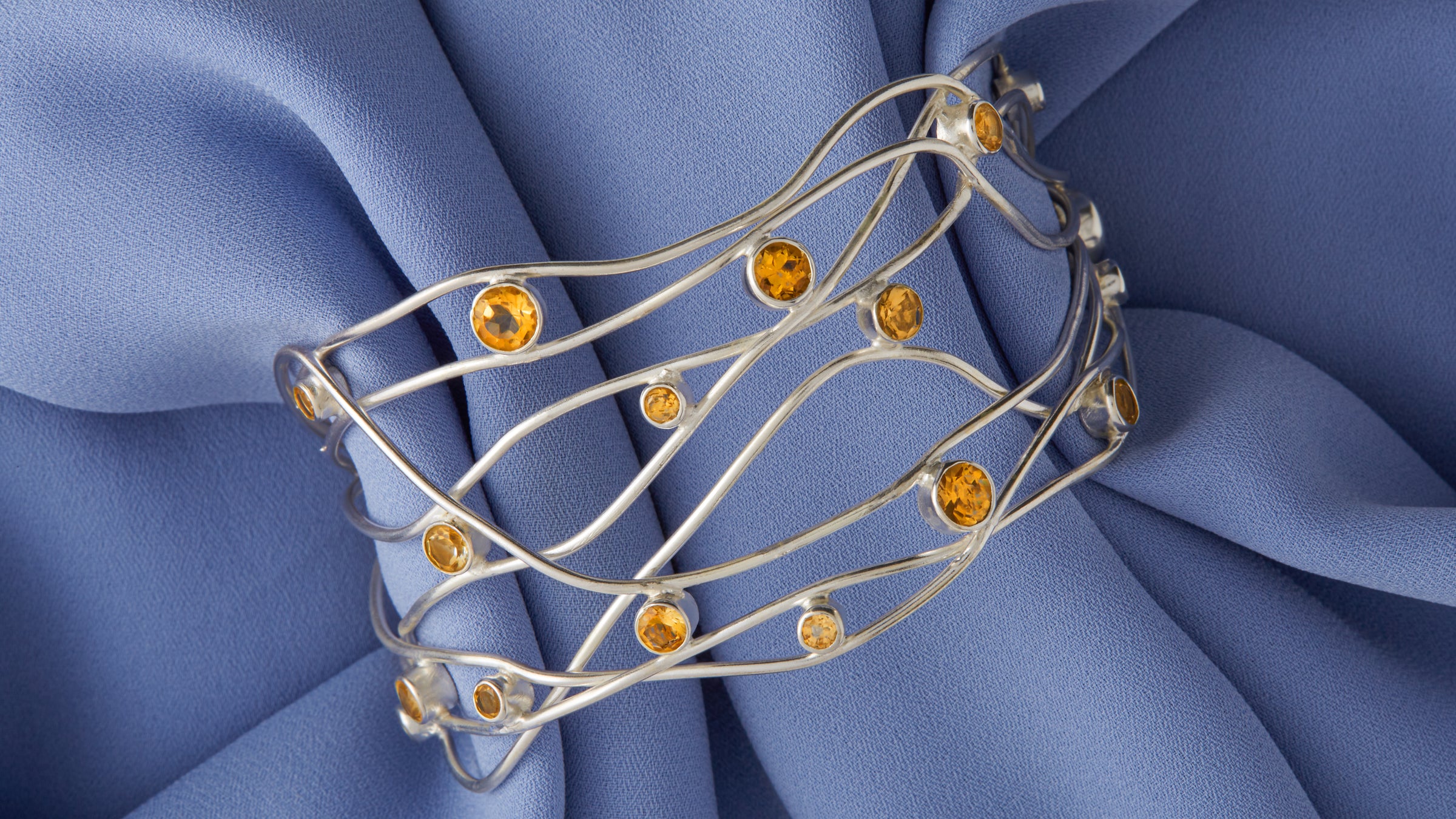
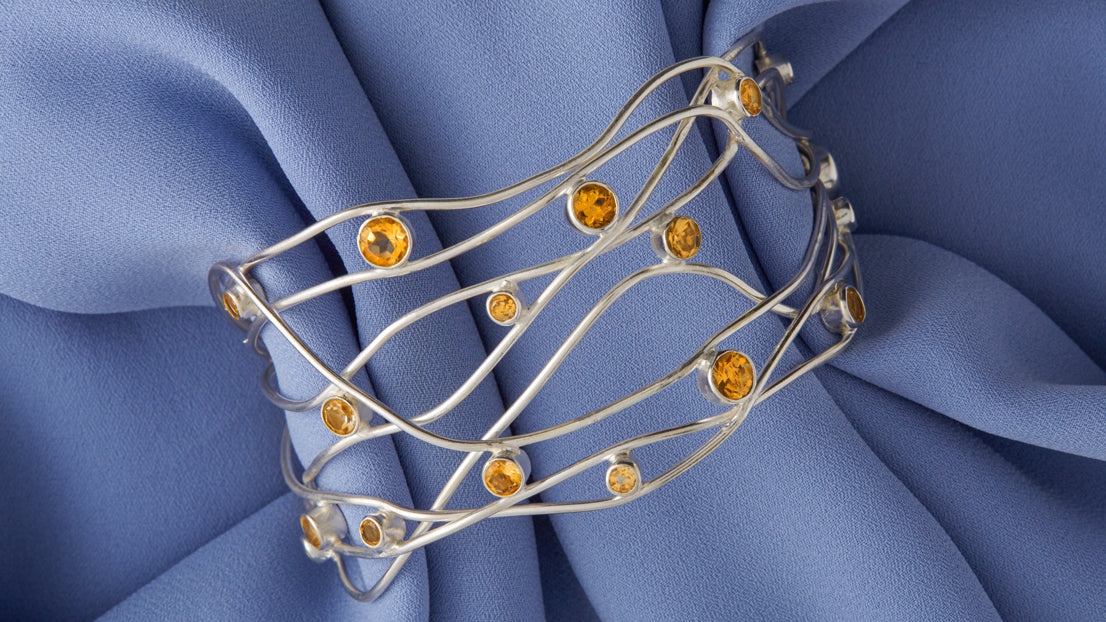
The name citrine is from the French "citron" meaning lemon.
Although the darker, orange colours of citrine, sometimes called Madeira citrine after the colour of the wine, has generally been the most valued colour, in modern times, many people prefer the bright lemony shades which mix better with pastel colours.
Citrine is generally less expensive than amethyst and is also available in a wide range of calibrated sizes and shapes, including very large sizes.
Most citrine is mined in Brazil.
In ancient times, citrine was carried as a protection against snake venom and evil thoughts. Pretty useful if you were an Egyptian peridot miner!
Citrine should not be confused with topaz which is a totally different mineral although similar in colour.
Citrine jewellery mostly features cut stones, often large.
Both citrine and topaz are birthstones for November. Citrine is the gemstone for the thirteenth wedding anniversary.
See our citrine pendants, citrine necklaces, citrine earrings and our citrine cufflinks. [Back to top] [Home]
[Back to top] [Home]
Dalmation
Like the breed of dog, dalmation has a cream ground with brown and black spots. A type of jasper it increases patience, removes disillusionment, increases loyalty to ones partner and is beneficial to long term relationships.
Garnets belong to the group of gems that come in all shades except blue.
Tsavorite garnet is a bright yellow green to grass green colour, and is mined in Tanzania and Kenya.
Legendary demantoid garnet combines bright green with a dazzling brilliance that seduced the Tsars of Russia, who used it lavishly. Unfortunately demantoid garnet was only ever available in small sizes and is extremely rare today!
Malaya garnet, another popular mixed variety, ranges from orange to gold and is mined in Tanzania and Kenya.
Pyrope garnet is a very saturated red. Beautiful small pyrope garnets found in Arizona are called anthill garnet because they are mined by ants, who carry them up to the surface when they are excavating their anthills.
One garnet growing in popularity is newly discovered in Namibia. It is a bright orange spessartite and is called mandarin garnet because its colour is a true orange.
Hessonite and Spessarite garnets mostly come in golds, oranges and browns and are sometimes called cinnamon garnets.
Grossular, the variety of garnets that gives us tsavorite, is also available in pale pinks, greens and yellows.
With the exception of demantoid, garnet is a hard gem and ideal for jewellery. It also has uses in industry as an abrasive for wood, glass, metal, plastic and leather. It forms in cubic crystal structure.
Garnet is said to stimulate the bloodstream & pituitary gland and combats depression and lethargy. It should be carried close to the body and possesses balancing and peaceful energy. Definitely one for my husband to carry!
Garnet symbolizes fire, faith, courage, truth, grace, compassion, constancy and fidelity.
Garnets are most often used as cut gems in earrings, rings, necklaces pendants and bracelets but are sometimes used in cabochon form when they resemble glossy red jellies.
Garnet is the birthstone for January and the gemstone for the second wedding anniversary.
See our range of garnet earrings, garnet necklaces, garnet pendants, garnet bracelets and garnet cufflinks.[Back to top][Home]
Iolite was the secret weapon of the seafaring Vikings as they used slithers of Iolite in the first polarising filter. Using an Iolite lens they could determine the direction of the sun and therefore the direction of travel
The property that made iolite so valuable to the Vikings is extreme pleochroism (there's that impressive word again, first encountered in Tourmaline). Iolite is different colours in different directions in the crystal. A cube cut from iolite will look a violet blue almost like sapphire from one side, clear as water from the other, and a honey yellow from the top.
Pleochroism may have been helpful in navigation but it makes things difficult for a gem cutter. If iolite is not cut from exactly the right direction, no matter the shape of the rough, its colour won't show to its best advantage.
Iolite is attractive and affordable and relatively hard.
It is mined in India, Sri Lanka, Mozambique, Zimbabwe, and Brazil. The Vikings probably mined iolite from deposits in Norway and Greenland.
Iolite is the gemstone of the 21st Wedding Anniversary.
See our collection of iolite pendants, iolite bracelets and iolite earrings.
Like Moonstone, labradorite displays a shiller of iridescent colour called labradorescence which is the result of lamellar intergrowths inside the crystal. These intergrowths result from compatible chemistries at high temperatures becoming incompatible at lower temperatures and thus separating and layering.
The resulting colour effect is caused by a ray of light entering a layer and being refracted back and forth by deeper layers. This refracted ray is slowed by the extra travel through the layers and mixes with other rays to produce a light ray coming out that has a different wavelength to that when it went in. The wavelength could correspond to the wavelength of a particular colour, such as blue.
Clearly a lot of effort went into creating this stunning stone!
It is normally cut into cabochons to show off the brilliant play of intense colours which include blues, greens, golds and violets. Labradorite cabochons make beautiful pendants.
Labradorite is found in Labrador, Canada and the Scandinavian Peninsula.
Labradorite is said to heal mental confusion and indecision.
See our range of labradorite pendants, labradorite bracelets, labradorite necklaces and labradorite earrings if you cannot decide what to buy.[Back to top][Home]
When lapis was first introduced to Europe, it was called ultramarinum, which means beyond the sea. Ground lapis was the secret of the blue in ultramarine, the pigment which painters used to paint the sea and the sky until the nineteenth century. Lapis was also popular in inlays.
Although lapis, as it is often called, is deep blue, its colour does show variation depending on its source and exact composition. Some material is lighter blue or greenish blue, some a rich purple blue, almost black. The best colour is an intense deep blue.
It usually contains golden flecks of pyrites. These are normally regarded as increasing the desirability, and are an indication of authenticity. Lapis also contains calcite, which sometimes shows as white flecks. These flecks are regarded as decreasing its beauty and desirability especially if they are large or numerous, although tiny flecks can help to indicate that it is genuine.
Lapis lazuli is still mined at the deposits of the ancient world in Afghanistan and is also mined in Chile. Small quantities are also mined in Siberia, Colorado, the United States, and in Myanmar.
Lapis Lazuli is not very hard and can easily be scratched or chipped. Water can dissolve the stone's protective coating, hence clean your lapis lazuli jewellery with a soft dry cloth. It is porous and should be protected from chemicals and solvents.
Lapis is said to increase psychic abilities, be a cure for melancholy and for certain types of fever. Lapis lazuli eliminates negative emotions. It relieves sore throat pain.
Traditionally believed to increase mental clarity, virility, and calm, Lapis Lazuli is an energy focuser for teachers, lecturers and speakers. It enhances creative self-expression and is believed to be useful in relieving depression and promoting spirituality. Lapis Lazuli is also powerful during meditation.
Lapis shares the birthstone for September with Sapphire.
Lapis is the gemstone for the ninth wedding anniversary.
See our range of lapis lazuli earrings, lapis lazuli pendants, lapis lazuli necklaces and lapis lazuli cufflinks.[Back to top][Home]
The rarity of this beautiful stone and the skill required to work with it dictates its high price. There are different qualities of cabochons available, the best having no impurities (grey or brown marks). Our own selection of larimar jewellery is made using premium quality stone.
In Europe in the 1980s, Larimar was commonly known as the Atlantis Stone and even today, customers at mineral and gem shows (as well as Metaphysical shows) and events, often refer to and seek the Atlantis Stone, rather than Larimar.
In beautiful shades of soft aqua-blue and green it gets its colour from the copper content. It has a dappled appearance with white cloud-like patterns or cobweb-like reticulate patterns on the surface. The fabulous sea colours evoke the Caribbean waters - no other gem is quite like this.
Larimar purports to increase speech and communication skills, support the healing process (thymus), and increase the possibility of regulating thyroid gland malfunction. Larimar enables the flow of energy within a person and helps promote an open mind to changes and improvement. It also softens the stress and tension that problems bring.
Today, there are thousands of people - naturalists and those who practice alternative and holistic healing methods - who use Larimar to assist and reinforce the healing process. Its hardness varies from 5 to 8 and this depends on the colour of the stone; that is, the more intense blue or green the piece is the harder Larimar becomes.
Larimar is used in cabochon form in rings, pendants, necklaces, bracelets and earrings but only 10% of the stone mined is suitable for jewellery.
Coming from an island with much humidity, Larimar can be placed in clean fresh water for a few hours to be cleaned and also to absorb some water; you might be surprised of the outcome, specially if your piece has become somewhat clear due to, for example, too long sun exposure.
See our range of larimar earrings, larimar pendants and larimar bracelets.[Back to top][Home]
Malachite Malachite is a vivid green mineral of calcium carbonate. When polished, the bands and rosettes in shades of green are spectacular and very distinctive.
Usually found with azurite, which is blue, malachite has a nobbly surface. Intergrown banded azurite and malachite is found in Chessy near Lyons, France and is called chessylite.
Malachite is found in Romania, Zanbia, Congo, Russia and areas of the middle east.
Moonstone Moonstone is a variety of feldspar and the shimmer, which is called schiller or adularescence, is caused by the intergrowth of two different types of feldspar (orthoclase and albite), with different refractive indexes.
That's the science bit now for the legend!
The Romans thought that moonstone was formed out of moonlight and to this day in India; it is considered a sacred stone. The electric blue floating light is likened to the light of the moon.
Moonstones come in a variety of colours. The body colour can range from colourless to grey, brown, yellow, green, or pink. The clarity ranges from transparent to translucent. The best moonstone has a blue sheen, perfect clarity, and a colourless body colour
Fine moonstone is quite rare and becoming rarer. It is mined in Sri Lanka and southern India. The rainbow variety can also be found in Madagascar.
Moonstones are usually cut in a smooth-domed cabochon shape to maximize the effect. Sometimes they are carved to show a man-in-the-moon face. Moonstone beads also display the iridescent sheen very well and are simply stunning against a black dress.
Moonstone can be easily scratched as it has a hardness of 6. Store moonstones carefully and never allow two specimens to touch each other.
Moonstone is endowed with the healing power to align vertebrae and aid digestion. It is also known to soothe and balance the emotions. There you are put the Prozac in the bin!
Moonstone is the birthstone for June.
See our range of moonstone earrings, moonstone necklaces, moonstone pendants, moonstone bracelets and moonstone cufflinks..[Back to top][Home]
Onyx is a form of agate with parallel banding. This structure lends itself to cameo making.
Black Onyx is a luxurious chalcedony quartz with a fine texture and deep black colour. Natural black onyx is rare. Most black onyx used in jewellery today is produced by soaking agate in sugar solution and then heating in sulphuric acid to carbonise the sugar particles.
Onyx was very popular with the ancient Greeks and Romans. The name comes from the Greek word "onux", which means fingernail.
The legend behind the name goes something like this.
One day a playful Cupid cut the divine fingernails of Venus with an arrowhead while she was sleeping. He left the clippings scattered on the sand and the fates turned them into stone so that no part of the heavenly body would ever perish. True, black isn't normally the colour one associates with fingernails but then Venus may have been a closet "Goth". However, in Greek times, almost all colours of chalcedony from ivory/white to dark brown and black were called onyx. Later, the Romans narrowed the term to refer to black and dark brown colours only.
Black onyx is often used in cabochon form in pendants and necklaces but is also stunning when cut into angular shapes for use in pendants, necklaces and earrings. It is also popular in marquisite jewellery.
This gemstone is reputed to eliminate negative thinking and to sharpen the wits of the wearer. Onyx is said to bring spiritual inspiration. It is a great assistance in holding emotions and passions under control.
Black Onyx is used to help one change habits.
Onyx is the birthstone for July (shared with ruby and carnelian) and the gemstone for the seventh year wedding anniversary.
See our range of black onyx earrings, black onyx pendants, black onyx bracelets and black onyx cufflinks.[Back to top][Home]
Thus pearl is a pathological formation. A foreign body enters into the gap between the body and the shell of the pearl oyster. The irritation caused by the foreign particle makes the oyster secrete to cover the particle. Relief from irritation is short lived as when the secretion dries, it once again irritates the mollusc's soft body and the secretion process begins again. After 2 to 3 years a prized and beautiful pearl has formed out of the discomfort of the oyster!
Highly valued as a romantic and famous gemstone, pearl is recognized for its timeless beauty and elegance.
Pearl is found in many different colours depending on the mollusc and the environment ranging from white, through pastel pink, yellow, lilac, blue, green and grey to black. The rose colour of Indian pearls is the most sought-after.
Pearls are characterized by their translucence and lustre and by a delicate play of surface colour called orient. The more perfect its shape (spherical or drop-like) and the deeper its lustre, the greater its value.
Only those pearls produced by molluscs whose shells are lined with mother-of-pearl (e.g., certain species of both saltwater oysters and freshwater clams) are really fine pearls. Pearls from other molluscs are reddish or whitish, porcellaneous, and lacking in pearly lustre.
The surface of a pearl is rough to the touch. Pearls come in a wide range of sizes. Those weighing less than 1/4 grain (1 pearl grain = 50 milligrams = 1/4 carat) are called seed pearls.
Cultured pearl is natural but produced by a mollusc after the intentional introduction of a foreign object inside the creature's shell. Cultured pearls are being produced in all colours.
Pearl is the birthstone for June and the gemstone for thirty years of marriage.
See our range of
See our range of pearl earrings. Some of our bracelets feature pearl decoration.[Back to top][Home]
Peridot Born out of fire, this rich green gem is found in volcanic rock. It has also been found in meteors (pallasites) that have fallen to earth - now that is a rare gem stone!
The name peridot is thought to derive from the French word meaning unclear and also from the Arabic faridat meaning gem.
It comes only in green varying from yellow/green to rich bottle and is the gem form of the mineral olivine. The proportion of iron in the mineral determines the shade. The more iron the browner the colour. The most attractive and sought-after peridots are rich green.
Peridot was mined in ancient Egypt on an island called Zeberget. Mining was done at night because legend said that peridot could not be easily seen during the day. The island was infested with serpents which made peridot mining a very hazardous occupation until one Pharaoh finally had them all driven into the sea.
Today most peridot is mined by Native Americans in Arizona on the San Carlos Reservation. Fine large peridots are found in Myanmar (formerly Burma) and peridot is also mined in China and Sri Lanka.
The Romans called peridot "evening emerald," since its green colour did not darken at night but was still visible by lamplight. Peridot was later often used to decorate mediaeval churches, probably carried back to Europe by the Crusaders. Large peridots, more than 200 carats in size, adorn the shrine of the three magi at the Cologne Cathedral.
Peridot had the power to drive away evil spirits and the power was considered to be even more intense when the stone was set in gold. It was also said to strengthen the power of any medicine drunk from goblets carved from the gemstone.
The peridots used in today's jewellery are usually small cut gems making up delicate earrings, necklaces and bracelets.
Peridot is the birthstone for August and the gemstone for the sixteenth wedding anniversary.
See our range of peridot earrings, peridot necklaces, peridot pendants,and peridot bracelets.[Back to top][Home]
Prehenite
Gem quality Prehnite or Prehenite is a rare, translucent to transparent semi-precious gemstone. It is usually green, clear or yellow in colour and has a jelly like appearance. The gemstone is textured with fibrous inclusions giving it a fascinating appearance.
It is named after a Dutchman, Colonel Prehn who is said to have brought the gemstone from Africa to Europe around 1774.
A powerful psychic amplifier it is said to aid prophecy and as it is considered a feminine stone it is held to improve endurance rather than physical strength.
See our range of prehenite pendants.
Rose Quartz The pale pink colour of quartz, which can range from transparent to translucent, is known as rose quartz.
The colour is a very pale and delicate ice pink, the result of titanium and iron impurities in the quartz. Transparent rose quartz is very rare and is usually so pale that it does not show very much colour except in large sizes.
The translucent quality of rose quartz is much more available and is used for beads, cabochons, carvings, and architectural purposes.
Some rose quartz contains abundant, tiny, rutile crystals - like needles - that give the stone a star effect when the light shines on it. This is often seen in cabochons used to make pendants.
See our range of rose quartz earrings, rose quartz necklaces, rose quartz pendantsand rose quartz bracelets. Smokey Quartz Smokey quartz is a brown transparent quartz that is sometimes used for unusual faceted cuts. The brown colour is a result of aluminium impurities in the quartz.
The commercial market is limited due to the small demand for brown gemstones. However, cut gems are used for pendants, necklaces and earrings set in either silver or gold.
This variety was sometimes known as smokey topaz in the past, which is incorrect and misleading, since the mineral variety is quartz, not topaz. See our range of smokey quartz earrings, smokey quartz necklaces, smokey quartz bracelets and smokey quartz cufflinks[Back to top][Home]
Rhodochrosite and Rhodonite Rhodochrosite and rhodonite are pink manganese minerals but distincly different in appearance.
Banded rhodochrosite became popular as an ornamental stone in the 1930's after fine quality stone was discovered in Argentina. Later in 1974 a new important source was discovered in South Africa. Sweet Home mine in Colorado is considered the best source of fine clear crystlas.
Rhodonite is found in Russia, Australia, Sweden, Brazil, Mexico and Britain.
Both rhodochrosite and rhodonite are most often used in jewellery in cabochon form. As each piece is individual, the stones make unique pieces of jewellery.
Banded rhodochrosite of good quality has shades of luscious rose pink mixed with creams. The most popular rhodonite is deep pink with black. The black areas are formed by concentrations of manganese oxides.
Aside from its gorgeous appearance, Rhodochrosite represents selfless love and compassion and imparts a positive attitude - definitely a gem to offer as a gift.
Rhodonite nurtures love, blances the emotions allowing one to see both sides of the debate and encourages a spirit of humanity - definitely one for world peace.
See our wonderful rhodochrosite pendants, rhodochrosite earrings and rhodochrosite bracelets. [Back to top][Home]
Ruby and Sapphire Ruby is the red variety of the mineral corundum, one of the hardest minerals on Earth, of which sapphire is also a variety.
Pure corundum is colourless. Slight traces of elements such as chrome, iron, titanium or vanadium are responsible for the colour.
These gemstones have excellent hardness. On the Mohs scale their score of 9 is second only to that of the diamond.
Only red corundum is entitled to be called ruby, all other colours being classified as sapphires. With rubies, the colour is everything (Burmese rubies being the best red colour), the clarity is secondary to colour.The most common colour of sapphire is blue which gets its colour from iron and titanium.
Ruby and sapphire take a brilliant and lasting polish which adds a glittering lustre to the colours.
Rubies are found in the Mogok area of Myanmar (was Burma), Kenya, Tanzania and Zimbabwe. Sometimes rubies are found in marble but most often in river gravels.
Some rubies display a wonderful silky shine, the so-called 'silk' of the ruby. This phenomenon is caused by very fine needles of rutile. Occasionally, one of the rare star rubies is found. Here too, the mineral rutile is involved: having formed a star-shaped deposit within the ruby, it causes a captivating light effect known by the experts as asterism. If rubies of this kind are cut as half-dome shaped cabochons, the result is a six-spoked star which seems to glide magically across the surface of the stone when the latter is moved. Star rubies are precious rarities.
Sapphires are found in Sri Lanka, Kashmir (cornflower blue), Australia (dark blue and golden), Thailand, Cambodia and Madagascar.
Seraphinite Seraphinite, Serafine or clinochlore is a member of the chlorite group of minerals.
Clinochlore derives its name from the Greek "klino" meaning "oblique" or "inclined" and "chloros" meaning "green" as seraphinite is commonly coloured deep forest green to green-black with inclusions of silvery Mica.
It's a stunning feathery-textured stone and the name Seraphinite derives from from the Latin word "seraphin" referring to the first order of angels. The allusion to angels refers to the feathery wing patterns made by the silvery Mica contained within the stone. The stone surface has a pearly to glass-like lustre.
The most common source of this remarkable stone is eastern Siberia.
Seraphinite is a gemstone of spiritual enlightenment and can aid self-assessment to help you achieve peace and fulfilment.
It is found in regions of South Africa. The best stones come from Griqualand West.
Legend states that Roman soldiers wore tiger's-eye for protection in battle as it was thought to be all seeing due to its appearance.
It can be worn to strengthen convictions and acquire courage and confidence. Relieving high blood pressure, the gemstone is used for focusing the mind. This very warm stone is beneficial for the weak and sick.
Topaz sometimes has the amber gold of fine cognac or the blush of a peach and all the beautiful warm browns and oranges in between.
Blue Topaz, popular for rings, earrings, necklaces and bracelets, is a clear vivid bluebell colour produced by irradiating and heating colourless topaz.
Topaz is an aluminium silicate and grows in crystalline form in granites and pegmatites. It contains up to 20% water or fluorine the proportion of each affecting the colour and shape of the gem.
The higher the water content the pinker or browner the colour and the longer the crystals. The higher fluorine content creates the colourless, yellow and pale blue shades and a squatter crystal shape.
Although topaz is the hardest silicate crystal, like diamond it cleaves easily along a direction parallel to the base of the crystal.
Some gem quality crystals are huge and can weigh many kilos.
Wear topaz only if you wish to be clear-sighted. Legend has it that it dispels all enchantment and helps to improve eyesight as well! Definitely wear when the man from the time-share arrives!
The ancient Greeks believed that it had the power to increase strength and make its wearer invisible in times of emergency. Topaz was also said to change colour in the presence of poisoned food or drink.
Its mystical, curative powers waxed and waned with the phases of the moon: it was said to cure insomnia, asthma, and haemorrhages.
As topaz has a hardness of 8, keep your gems in separate boxes to protect other jewellery from scratches. Also avoid large temperature changes. Topaz often becomes paler if kept out in the sun.
Do not clean topaz in a home ultrasonic cleaner. The best way to clean topaz is in warm soapy water.
See our range of blue topaz earrings, blue topaz necklaces , blue topaz pendants and blue topaz bracelets.[Back to top][Home]
Tourmaline occurs in every colour of the rainbow and combinations of two or three colours. Banded bicolour and tricolour tourmalines are very popular. Sometimes the colours are at different ends of the crystal and sometimes there is one colour in the heart of the crystal and another around the outside. One colour combination, pink centre with a green rind, is called "watermelon tourmaline". Sometimes designers set slices of the crystal instead of faceted stones to show off this phenomenon.
The coloured varieties, when transparent and free from flaws, are cut as gems. Transparent crystals of tourmaline are dichroic - the depth of colour varies as the crystal is turned in the light.
Tourmalines are most often cut in long rectangular shapes because of their long and narrow crystal shape. Tourmaline crystals are beautiful - pencil thin and ridged - and these are sometimes set in jewellery. Some designers also set rainbows of tourmaline in each colour of the spectrum. Tourmaline is strongly pleochroic an impressive word that means the darkest colour is always seen looking down the axis of the crystal.
Tourmaline shares the birthstone for October with Opal.
Tourmaline is the gemstone for the eighth wedding anniversary.
See our range of tourmaline pendants, tourmaline bracelets and tourmaline earrings [Back to top][Home]
Turquoise is one of the oldest known minerals and takes its name from the French "turc" meaning Turkish. It is thought that turquoise was transported to Europe through Turkey.
One of the first gems to be mined, it also inspired early imitations. The Egyptians and the Aztecs valued turquoise for its beauty and used it widely in jewellery, mosaics and ceremonial costumes.
The Egyptians mined turquoise 6000 years ago in Sinai and quickly exhausted supply. Steatite imitations have been found in graves dated at 4000BC.
The best turquoise is mined in Nishapur in Iran although it is also available in south western USA, Africa, Tibet, China, Siberia, Europe and Australia.
Turquoise gets its colour from the copper and iron content and varies from blue (the influence of copper) to green (the influence of iron) to grey. The most sought-after colour is blue and the finest examples of this gem have no veining and a waxy texture. Some collectors prefer a little veining to verify its authenticity.
Turquoise is relatively soft and porous. It can be damaged and altered by hot water, chemicals such as make up, hair spray and household cleaners, prolonged bright light and skin oils. Some turquoise is treated to preserve its colour and lustre and care should be taken not to remove this finish. Turquoise will easily chip and scratch.
Given as a gift, Turquoise is believed by many to bestow wealth and happiness upon its receiver.
Turquoise is said to be a guard against all diseases. It assists in tissue regeneration, subtle body alignment & strengthening. Turquoise is also believed to bring happiness and good fortune to all. It's said that turquoise attracts healing spirits, making it a premier healing stone. Also believed to be a protective stone, turquoise is worn to guard against violence and accidents. Turquoise is also a valuable amulet for travellers.
Good value for money!
Turquoise is the birthstone for December and is the gemstone for the eleventh wedding anniversary.
See our range of turquoise earrings, turquoise necklaces, turquoise pendants, turquoise bracelets and turquoise cufflinks.[Back to top][Home]